Download for WindowsDownload für WindowsDescargar para WindowsTélécharger pour WindowsTransferir para WindowsBaixar para WindowsСкачать для WindowsWindows版をダウンロード下载 Windows 版
Download for macOSDownload für macOSDescargar para macOSTélécharger pour macOSTransferir para macOSBaixar para macOSСкачать для macOSmacOS版をダウンロード下载 macOS 版
Download for Debian/UbuntuDownload für Debian/UbuntuDescargar para Debian/UbuntuTélécharger pour Debian/UbuntuTransferir para Debian/UbuntuBaixar para Debian/UbuntuСкачать для Debian/UbuntuDebian/Ubuntu版をダウンロード下载 Debian/Ubuntu 版
Download for Red Hat/FedoraDownload für Red Hat/FedoraDescargar para Red Hat/FedoraTélécharger pour Red Hat/FedoraTransferir para Red Hat/FedoraBaixar para Red Hat/FedoraСкачать для Red Hat/FedoraRed Hat/Fedora版をダウンロード下载 Red Hat/Fedora 版
Download for Arch LinuxDownload für Arch LinuxDescargar para Arch LinuxTélécharger pour Arch LinuxTransferir para Arch LinuxBaixar para Arch LinuxСкачать для Arch LinuxArch Linux版をダウンロード下载 Arch Linux 版
What Is Bisq DAO? Decentralized Governance and BSQ Token Explained
The Bisq DAO is a decentralized governance and funding system that allows the project to evolve without a single company, bank account, or central control. It connects traders, project contributors, proposals, voting, and the BSQ token into a unified ecosystem that supports open-source development and community governance. Bisq’s DAO has run on Bitcoin since early 2019 without a major failure.
Introduction
The Bisq DAO
The Bisq DAO unites traders, project contributors, proposals, voting, and the BSQ token into a unified governance system. This allows the platform to remain independent, decentralized, and community-driven.
Problem
Why a DAO?
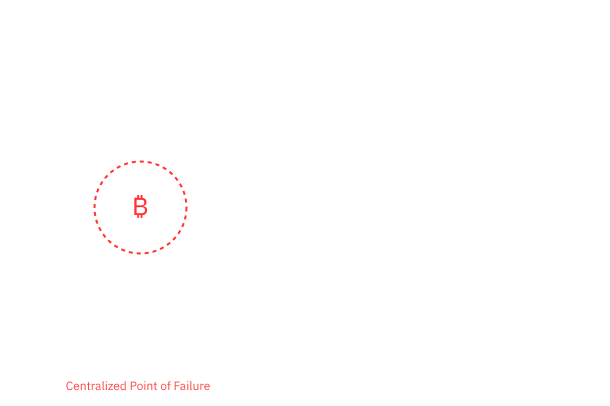
A decentralized exchange should not depend on a single company, bank account, or legal structure. These become points of failure. The DAO reduces this dependence and makes the project more resilient.
Solution
The BSQ Token
BSQ is the token of the Bisq ecosystem. It connects traders and project contributors: contributors receive BSQ for their contributions, and traders use it within the system, for example, to pay fees.
Mechanics
How it Works
The DAO runs on a ~1-month voting cycle of proposals, blind voting, and vote reveal, all timed in Bitcoin blocks. Approved proposals receive BSQ funding directly from the DAO.
Result
Benefits
The DAO helps Bisq remain an open, decentralized, and independent project. It supports platform development, rewards contributors, and reduces reliance on centralized structures.
Why the BSQ Token is Important
BSQ is not just a token within Bisq. It links the use of the platform, participant rewards, and the governance system, while granting discounts on trading fees. When contributors receive BSQ for their work and traders use it within the system, a closed loop is created that supports the project’s development. Trading fees paid in BSQ are burned, permanently removing them from supply — the more the network is used, the more BSQ is destroyed over time.
The Monthly Voting Cycle
Everything the DAO does runs on a fixed cycle of roughly one month, measured in Bitcoin blocks rather than calendar days, so the exact length varies slightly with block times:
~24 days
Proposal Phase
3,600 blocks. Anyone can submit a proposal for a small anti-spam fee. Requests for new BSQ issuance (compensation) go here.
~1 day
Break
150 blocks. Time for the community to review and discuss proposals before voting opens.
~3 days
Blind Voting
450 blocks. Any BSQ holder can approve, reject, or abstain. Votes are encrypted and broadcast on the P2P network, and cannot be changed once published.
~3 days
Vote Reveal
450 blocks. Bisq automatically publishes decryption keys — your software must be online during this phase or your vote is invalidated.
~100 min
Vote Result
10 blocks. Revealed votes are decrypted and tallied; approved proposals are funded in BSQ.
The 80% rule.
For a voting cycle’s results to count at all, the winning outcome needs at least 80% of the total vote stake behind it. Fall short, and the entire cycle — every proposal in it — is invalidated and nothing passes.
How Voting Weight Works
Not all BSQ carries equal weight in a vote. Bisq combines two components into your total voting power:
Component
What it is
Detail
Reputation
BSQ earned through contributions to the project
Decays linearly over 2 years — after 1 year it’s worth 50% of its original weight
Stake
BSQ you actively lock up for a specific vote
Made unspendable for the cycle; more staked BSQ means more voting weight
This design is deliberate: BSQ earned by doing work for the project carries more governance influence than BSQ simply bought on the market, which keeps decision-making weighted toward active contributors rather than passive holders.
Compensation Requests
Contributors — developers, translators, moderators, and other project workers — get paid in BSQ through compensation requests submitted during the proposal phase. A request specifies the work done and the BSQ amount asked for (new BSQ issuance costs roughly 100 satoshis per BSQ token to request). If the community approves it in that cycle’s vote, the requested BSQ is issued directly to the contributor — there’s no invoice, company payroll, or bank transfer involved.
Why This Matters for Users
Regular users do not need to understand every detail of the DAO to use Bisq. However, it is the DAO that explains why the platform remains independent, open-source, and resilient against central control — every developer who fixed a bug or added a feature was very likely paid by this same monthly voting cycle, not by a company payroll.
Frequently Asked Questions
The Bisq DAO governs the platform through decentralized proposals, voting, and community participation, cycling roughly once a month. It helps manage development, funding, and critical decisions without a central authority.
The DAO makes it possible to reduce dependence on companies, banks, and centralized structures, all of which would otherwise be single points of failure for a decentralized exchange.
Not strictly required to start — you can trade on Bisq without ever holding BSQ. But paying trading fees in BSQ instead of BTC is cheaper, and it plays an important role in the wider ecosystem.
About one month, made up of a 24-day proposal phase, a 1-day review break, a 3-day blind voting phase, a 3-day vote reveal phase, and a short vote-counting phase. The cycle is measured in Bitcoin blocks, so exact real-world length varies slightly.
It secures the development, management, and funding of the project through the community, paying contributors in BSQ through the same monthly voting cycle that decides everything else.